
Photos: August 16, 2016
Woody Point is so well located with a view towards Gros Morne across the bay and the tablelands at the other end of the bay. Our hotel had a panoramic view of the bay – a wonderful view to wake up to, to have breakfast - to just enjoy. We set out to visit the tablelands where we had already been in 2009. On one side of the road is a mainly barren series of peaks, on the other a forested mountain. It is one of the places on earth where the Earth’s mantle was thrust up and is visible. Not much grows here as the soil is rocky and full of heavy metals. It is quite something to see the reddish mountains on one side of the road and the green forested mountain on the other side.

This is the result of the collision of the ancient continent of Laurentia (now part of North America) and Gondwana (now part of South America, Africa and Antarctica). The Iapetus Ocean, which had been between them was thrust up forming Pangaea. Newfoundland is a combination of the three with the tablelands being from parts of Earth's mantle that was pushed upwards.

Much of the rock is peridotite - it gets its reddish-yellow tinge from oxidization. The black section is serpentine - the white lines being calcium which has come to the surface of the rock.

We hiked up near a waterfall.

Growth is slow with trees that grow horizontally and may be hundreds of years old. Their wood is extremely dense

Paul gazed at every rock, in awe of the geology and I gawked at every flower that managed to grow in this environment.
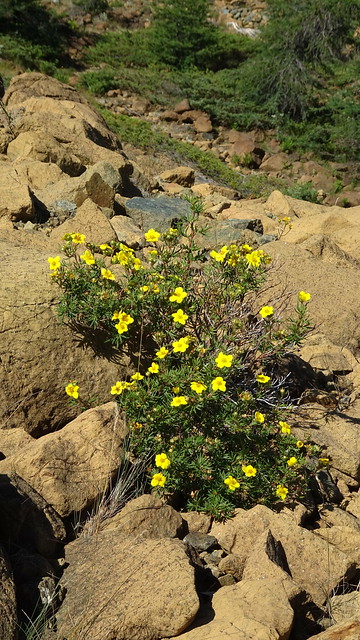
I think this is shrubby cinquefoil.
And a few more flowers


This is a pitcher plant - the provincial flower of Newfoundland and Labrador. It captures insects in its leaves. They in turn are digested by larvae who then excrete waste. It is this that nourishes the flower.

You can see how the leaves form tubes that are filled with liquid.
We had to continue on...

We explored the south coast of the Humber Arm and stopped at Frenchman's Cove. For many years the French had fishing rights on this coast of Newfoundland. These are fishing dories.

Larger craft also fish out of this harbour.

The season for whatever this area fishes for must have been over as all the dories seemed to be pulled up out of the water.

We checked in to the Glynmill Inn in Corner Brook. It was built originally in the 1920's as the "staff house" for senior staff of a paper company.

It is right near the pond in Corner Brook.

A beautiful moon ended our day.
These and more picture
can be found here.


