Showing posts with label Newfoundland. Show all posts

Sunday, August 21, 2016

Retracing Our Steps

Closing the Gate

Photos: August 18, 2016

The last of the trucks loaded on the upper deck, the gate began to close. It was time to leave "The Rock."

Lighthouse Near Port aux Basques

Last looks at the rocky shore...

Dolphins

Crossing the Cabot Strait was not quite as smooth as the way there. I found a spot on a bench on the upper deck and lay down. A young girl started yelling excitedly and I got up to see a school of dolphins swimming by.

Some thoughts on Newfoundland 
This is a rugged place. When we spoke with the guide at L’Anse aux Meadows Historic Site, he told us they had no electricity or roads to the community when he was a boy. It was an outport – a community that had to be independent and yet dependent on each other. Communities like this are mainly close-knit with families helping others when they are in need. Like the flowers that grow despite the difficult conditions, Newfoundlanders learned to cope with storms, isolation, difficult work without much access to people outside their community. When the archaeologists arrived in L’Anse aux Meadows, it was again the meeting up of people of two different cultures. These twentieth century Europeans encountered the rural Newfoundlanders who opened their homes to them. Friendly, unpretentious and ready to party – they create their own fun - playing music, creating festivals focused around the environment they live in, from the Mussel Festival in St. Lunaire-Griquet while we were there to the Bakeapple Festival in Forteau just after we left. Kitchen parties in people’s homes are open to many. The chef at Forteau told us he had 60 at his place on the Monday we had arrived and felt bad we had not been invited when he realized the next day that we liked music.
Story-telling and song have a strong tradition in Newfoundland.
And Newfoundland has some wonderful writers.
Here are some I have read and enjoyed:
Wayne Johnston – A Colony of Unrequited Dreams (he has written others since which I have not read)
Donna Morrissey – I like her earlier books best
Bernice Morgan – Random Passage
Kathleen Winter – Annabel
Michael Crummy – I read River Thieves on my last trip to Newfoundland – I’ve had Galore waiting for me but still have not got around to it.
Lisa Moore – February

Newfoundland has developed its own culture, a lot of unique vocabulary, a great sense of pride in their home. But we had to leave and head home.

Near North Sydney

Back to Cape Breton to begin our long drive home.

Saturday, August 20, 2016

The Tablelands and Corner Brook Area

Land Divided

Photos: August 16, 2016

Woody Point is so well located with a view towards Gros Morne across the bay and the tablelands at the other end of the bay. Our hotel had a panoramic view of the bay – a wonderful view to wake up to, to have breakfast - to just enjoy. We set out to visit the tablelands where we had already been in 2009. On one side of the road is a mainly barren series of peaks, on the other a forested mountain. It is one of the places on earth where the Earth’s mantle was thrust up and is visible. Not much grows here as the soil is rocky and full of heavy metals. It is quite something to see the reddish mountains on one side of the road and the green forested mountain on the other side.

Tablelands Peaks

This is the result of the collision of the ancient continent of Laurentia (now part of North America) and Gondwana (now part of South America, Africa and Antarctica). The Iapetus Ocean, which had been between them was thrust up forming Pangaea. Newfoundland is a combination of the three with the tablelands being from parts of Earth's mantle that was pushed upwards.

Serpentine Rock

Much of the rock is peridotite - it gets its reddish-yellow tinge from oxidization. The black section is serpentine - the white lines being calcium which has come to the surface of the rock.

Waterfall

We hiked up near a waterfall.

Trees Hug the Ground

Growth is slow with trees that grow horizontally and may be hundreds of years old. Their wood is extremely dense

Walking on the Tablelands

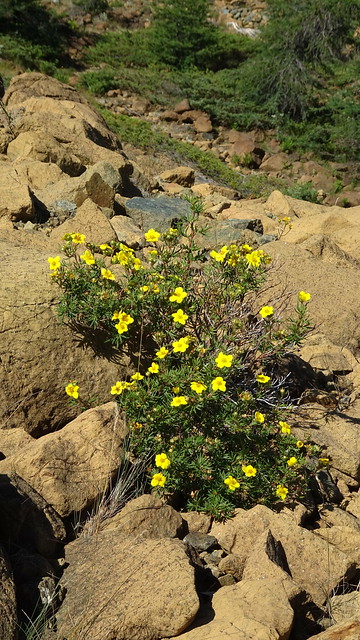
Paul gazed at every rock, in awe of the geology and I gawked at every flower that managed to grow in this environment.

Shrubby CinquefoilI think this is shrubby cinquefoil.

And a few more flowers

Single Yellow Flower

Pitcher Plant

This is a pitcher plant - the provincial flower of Newfoundland and Labrador. It captures insects in its leaves. They in turn are digested by larvae who then excrete waste. It is this that nourishes the flower.

Pitcher Plant

You can see how the leaves form tubes that are filled with liquid.

We had to continue on...

Dories in Frenchman's Cove

We explored the south coast of the Humber Arm and stopped at Frenchman's Cove. For many years the French had fishing rights on this coast of Newfoundland. These are fishing dories.

Well Equipped

Larger craft also fish out of this harbour.

Hauled Up

The season for whatever this area fishes for must have been over as all the dories seemed to be pulled up out of the water.

Glynmill Inn

We checked in to the Glynmill Inn in Corner Brook. It was built originally in the 1920's as the "staff house" for senior staff of a paper company.

Pond in Corner Brook

It is right near the pond in Corner Brook.

Moon Over Corner Brook

A beautiful moon ended our day.

These and more picture can be found here.

Wednesday, August 17, 2016

From St. Lunaire-Griquet to Cow Head

Old Fishing Shed

Photos: August 14, 2016

The sky was so clear you could see for many kilometers - right across the strait to Labrador. With binoculars we could see the lighthouse we had visited just a few days earlier.

Cable Laying Ship

The perspective on this photograph is off, but this is the ship we think we saw from the Labrador coast. It looks near, but is out in the strait. We think it is the ship that is laying cable across the strait as part of the Muskrat Falls hydro-electric project.  The little strip of blue it sits on is actually the Strait of Belle Isle and may be about 30 km wide here (I have found very conflicting articles about the width of the strait). The land behind is Labrador.

Flowers Cove Lighthouse on a Clear Day

We passed by Flowers Cove again - this time on a sunny day. The lighthouse looked crisp in the clear air.

Cow Head Heads

Our destination for the day was Cow Head. We went for a hike on the peninsula. These are Cow Head heads at at the amphitheatre.

View Towards Cow Head and the Long Range

There are great views along the way. Here we were looking back to the community of Cow Head with the Long Range Mountains in the background.


Cow Head Lighthouse

This lighthouse is no longer in use, but its exterior is maintained.

Berries

Berries grow in abundance here. I think these are bunchberries.

Indian Pipe or Ghost Plants

I had never seen these flowers before. They are called Indian Pipes or Ghost Plants. It seems they are edible in small quantities.

Sunset at Cow Head

With so much coast, weather-permitting there are always lovely sunsets to end the day.

Thursday, August 11, 2016

An Extra

Cow Parsnip

I've been enjoying the wild flowers. A lady suggested this was the toxic giant hogweed, but I did a little research. While giant hogweed has been found in Newfoundland, these flowers: cow parsnip are found everywhere. This article outlines the difference. Cow parsnip is found everywhere in Newfoundland, in many gardens but also growing wild.

Wild Flowers

The flowers glowed in the evening light.

Grasses

These are quite common - Canadian burnet.

The Shore in the Evening

And to whet your appetite...

Cod Tongues With Scrunchions

Cod tongues with scrunchions and here is the recipe.

Wednesday, August 10, 2016

Exploring up the Coast

The Marjorie Bridge

Photos: August 7, 2016

We drove up the coast to Flowers Cove. It was a short hike, over the bridge, which was erected about 100 years ago, to see something that can only be seen in a few places in the world.

Thrombolites at Flowers Cove

These are thrombolites. To quote the sign nearby "These are critically endangered microbial structures. Thrombolites-building micro-organisms resemble the earliest forms of life on earth." It seems they exist in Australia as well.

Thrombolites

They feel like rock.

A Little Ecosystem

All along the path and even amid some of the thrombolites, there are wild flowers.  They thrive amid the rocks.

Beach Pea

I think these are beach peas.

Newfoundland Pond

Newfoundland is dotted with lakes and ponds. Some just seem to sit in a grassy area in a flat meadow, field or bog. Many have not even trees around them.

Fragile Growth in the Cracks

We went walking on White Stones trail which led to this area with limestone blocks. In the cracks a variety of plants grew but due to the lack of nutrients, they were stunted. There are flowers that grow in parts these poor soil conditions that do not grow elsewhere.

Tiny Growth

Little ecosystems thrived in small spaces.

Growing Near the White Stones

Trees which may be many years old, barely grow. Their branches may have life only on the very tips.

This is a Tree

This is a tree growing horizontally instead of vertically, totally stunted, but still alive.

Lichen


We spotted lichen and mosses growing together.

Tuesday, August 9, 2016

Bird Cove and Plum Point

Bird Cove

Photos: August 6, 2016

We woke up to driving rain. As we had a little "cabin" we were able to quietly have breakfast and just enjoy the daily pleasures of catching up on the world, reading and catching up on my blogging.

It is interesting to note that Plum Point writes about James Cook's time there in 1764. I learned that he was the first to map the entire coast of Newfoundland, no small task with its many bays and inlets, over a series of voyages.

By afternoon the rain had calmed and we went to Bird Cove where there was a small interpretation centre. A number of archaeological sites are active in the area and the centre focuses on 50 centuries of life with a number of interesting artifacts discovered in the area dating from different waves of first peoples from the Maritime Archaic Indians to the Groswater Paleoeskimos to the Dorset Paleoeskimos as well as Recent Indians. Now there are no first people living in the area.

Lobster Traps

What you do see everywhere is evidence of the fishing industry. Lobster season is over and the traps are piled up. Everyone knows whose is whose and respects that. Trust, respect and friendliness are important in these small communities. As you drive down the highway you can see rows of lobster traps stored.

Woodpile

Or long piles of wood (most more neatly stacked than these). - Again it is common knowledge whose wood it is and others would not take from a wood pile that is not theirs.

Loons

It is always nice to catch a glimpse of the local wildlife. We have seen a number of loons.


Along the Road

This part of Newfoundland is sparsely populated. Bird Cove has 182 people; Plum Point 128. Several communities share a school and health services. Yet each has its own church and sometimes more than one. A local store would have some food, non-prescription pharmacy items, motor oil, liquor and items for tourists. One larger store was both a hardware store and grocery store. With poor soil we saw no sign of vegetable gardens nor any livestock. Most sheds are for storing boats and other fishing equipment.